Michael Burstein: A Rising Star
by Lucy Cohen Schmeidler
Copyright © 1996 by Lucy Cohen Schmeidler.
First appeared in CyberCozen, edited by Aharon Sheer, a publication of the Rehovot (Israel) SF Society. Reprinted by permission of the author.
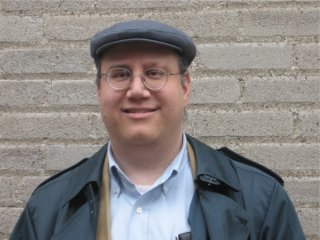
At twenty-six, Michael Burstein must be the youngest of the 1996 Hugo nominees, as well as the newest (in length of career). The fact that his first published story,the Hugo-nominated "TeleAbsence" (ANALOG, July 1995), only saw print last year is what makes him eligible also for a spot on the ballot for the Campbell Award for best new author.
So what does Burstein write? First of all, as a trained physicist, it is natural for him to write mostly hard SF, in which the plot is dependent on a future development in science or technology. And while it is certainly within his capability to imagine impossible scenarios, he is too much a scientist to devise such except by intention, as in his second published story, "Sentimental Value," which was a "Probability Zero" short short in the October issue of ANALOG.
"TeleAbsence" is what I think of as a feel-good story, in which the SF setting is used as background for a human interest plot which reinforces values that any right-minded reader already identifies with. In this story, it's the idea that a good education, in a supportive environment, should be available to every child, regardless of race or economic level; in Barry Longyear's "Enemy Mine" it was the idea that understanding leads to appreciation and friendship, even between people who have been taught to hate each other. While this is a category that always does well in reader polls, I tend to prefer stories that offer a new perspective, which I might never have considered on my own.
However, it takes considerable talent to take a plausible development (VR used to simulate an ideal classroom environment for a group of children who are physically located in cities spread across the country) and work a well-structured story around it, even if it has some knee-jerk sentimentality. And the sentimentality may be a better starting point for reader identification in less easily recognized scenarios than Greg Egan's much colder approach.
Before he was a Hugo-nominee, before he had even had a story accepted for publication, Michael attended the well-known Clarion workshop on a Wollheim Memorial scholarship, awarded by the New York Science Fiction Society (Lunarians), making him the protege of a whole bunch of New York fans, many of us old enough to be his parents. Whatever it was like to have us hovering over him as his stories took their first steps out in the world, he has never seemed daunted by it.
While Michael Burstein has some stories scheduled for upcoming issues of ANALOG, it would probably be premature to look for his name on the bookshelves of your favorite store's SF section. But wait a few years: space is huge, and he's just gotten started.